Situation
The existential challenge
In 2024, Glassdoor faced an existential threat that required fundamental transformation, not incremental improvements. The market was shifting:
SEO traffic declining 30% year-over-year due to ChatGPT and AI tools
Knowledge workers increasingly expecting personalized, AI-powered job seeking experiences
Traditional job boards becoming commoditized—users could find jobs anywhere
The Critical Business Question: How do we evolve from a transactional job board into an intelligent talent sourcing platform that retains users and drives revenue?
My roles & responsibilities
Design Strategy Lead
To transition from traditional browsing to AI interactions across Jobs, and Employer Profile.
Stakeholder alignment
With Product VPs, Engineering Directors, Data Science, and UXR teams
Cross-functional coordinator
across 5 product teams (Jobs, Clarity, Community, Employer Profile, Notifications)
See detailed team structure
Position #1
Position #3
Action
Strategic Design Approach
Looking at global trends and learning from competitors, leadership set an ambitious vision:
Position Glassdoor as the executive recruiter for 2.5M+ knowledge workers.
This required a paradigm shift:
From Apply-first metrics → To Connection-first metrics
From Transactional job board → To Relationship-based talent platform
From Users searching for jobs → To Users becoming discoverable candidates
My Strategic Proposal
I begun by reviewing product's requirements and gathering insights from data and research teams.
To transform our product, I recognized three high priority paint points that could be transformed with AI:
Goal #1
Job Searching
The Challenge
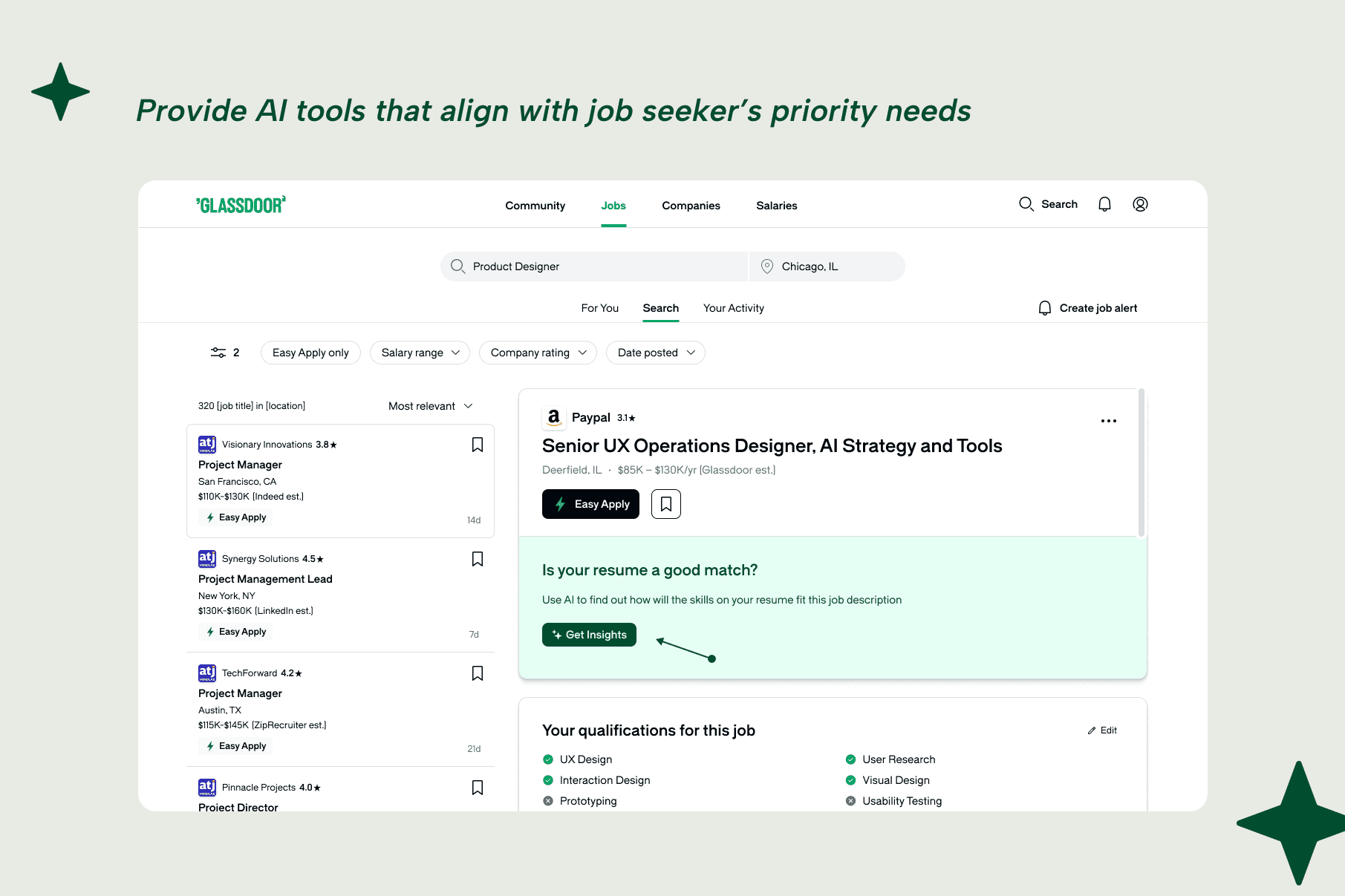
Users love Glassdoor's search and filter controls. They didn't want AI to replace their agency. Our research showed people wanted AI as an enhancement, not a replacement. The design question became: how do we add intelligence without disrupting high-intent job search behaviors?
My Approach
I designed a layered AI strategy that preserved user control while adding intelligent assistance at key decision points:
Smart delivery, not disruption → Instead of forcing AI into the core search interface, I positioned AI-powered job matching to start in email notifications. Users receive personalized matches in their inbox, then engage on their terms.
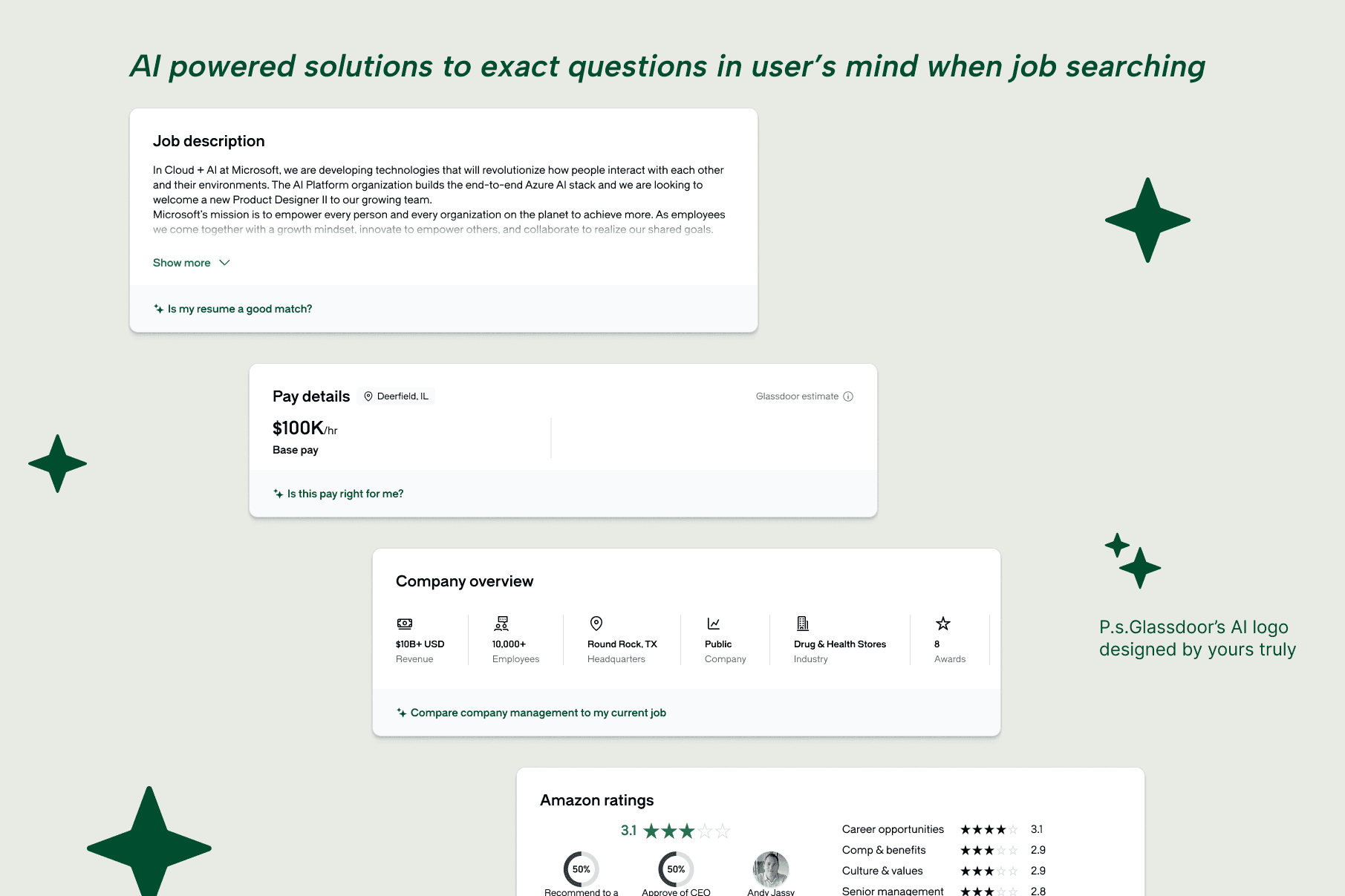
Decision support, not decisions → On the platform, AI helps users evaluate opportunities rather than choosing for them. It answers contextual questions about job requirements, personal fit, and company culture using Glassdoor's unique dataset of reviews and ratings—insights users can't get anywhere else.
Two-way matching → I integrated AI-powered sourcing into the job search flow, creating mutual connections. Job seekers showing high intent can opt into AI-assisted sourcing, while employers discover candidates through intelligent matching. It's collaboration, not just applications.
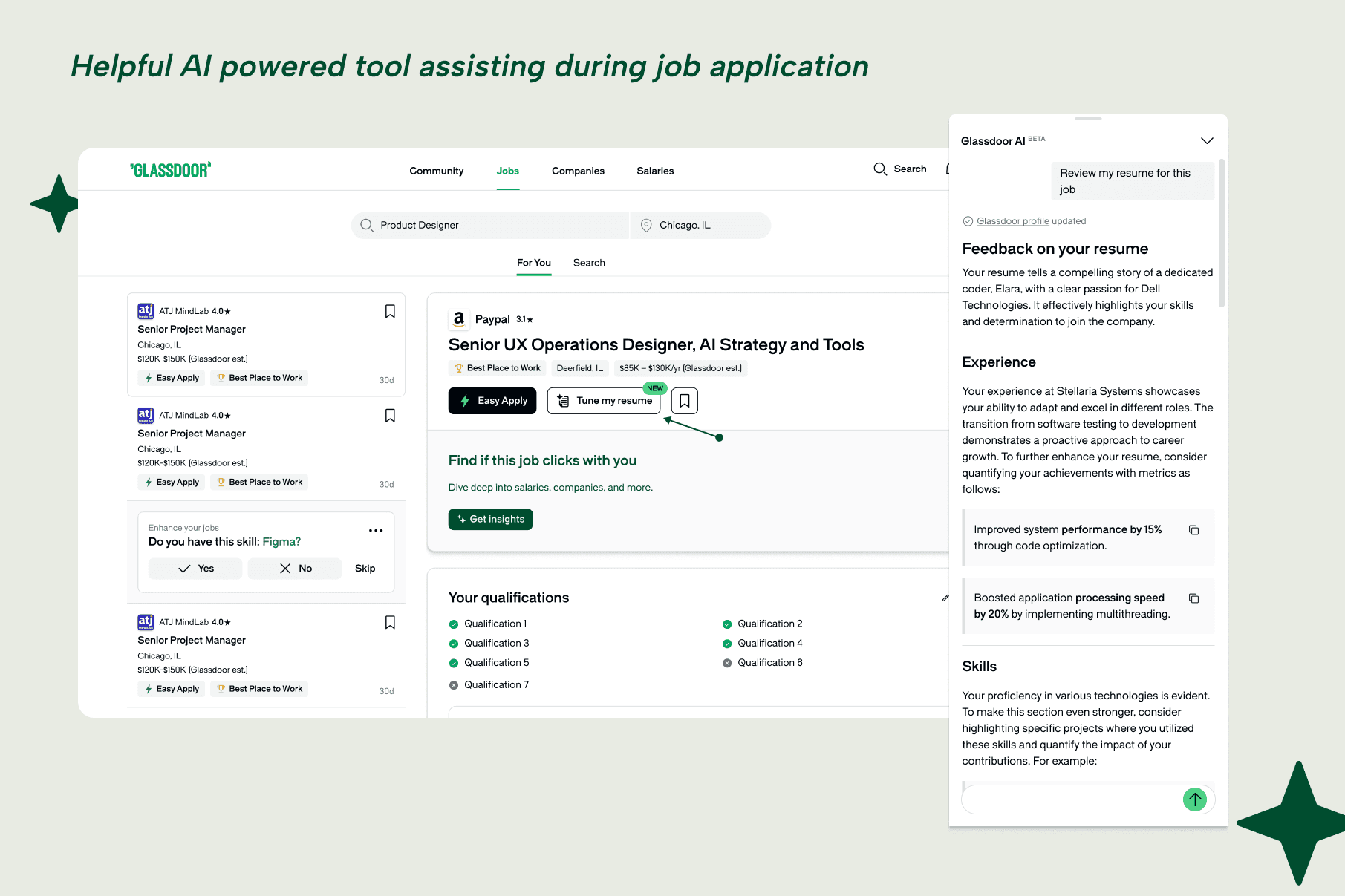
This foundation now enables next-quarter initiatives like AI-powered resume feedback and improvement suggestions.
Visuals
Goal #2
Company Insights
The Challenge
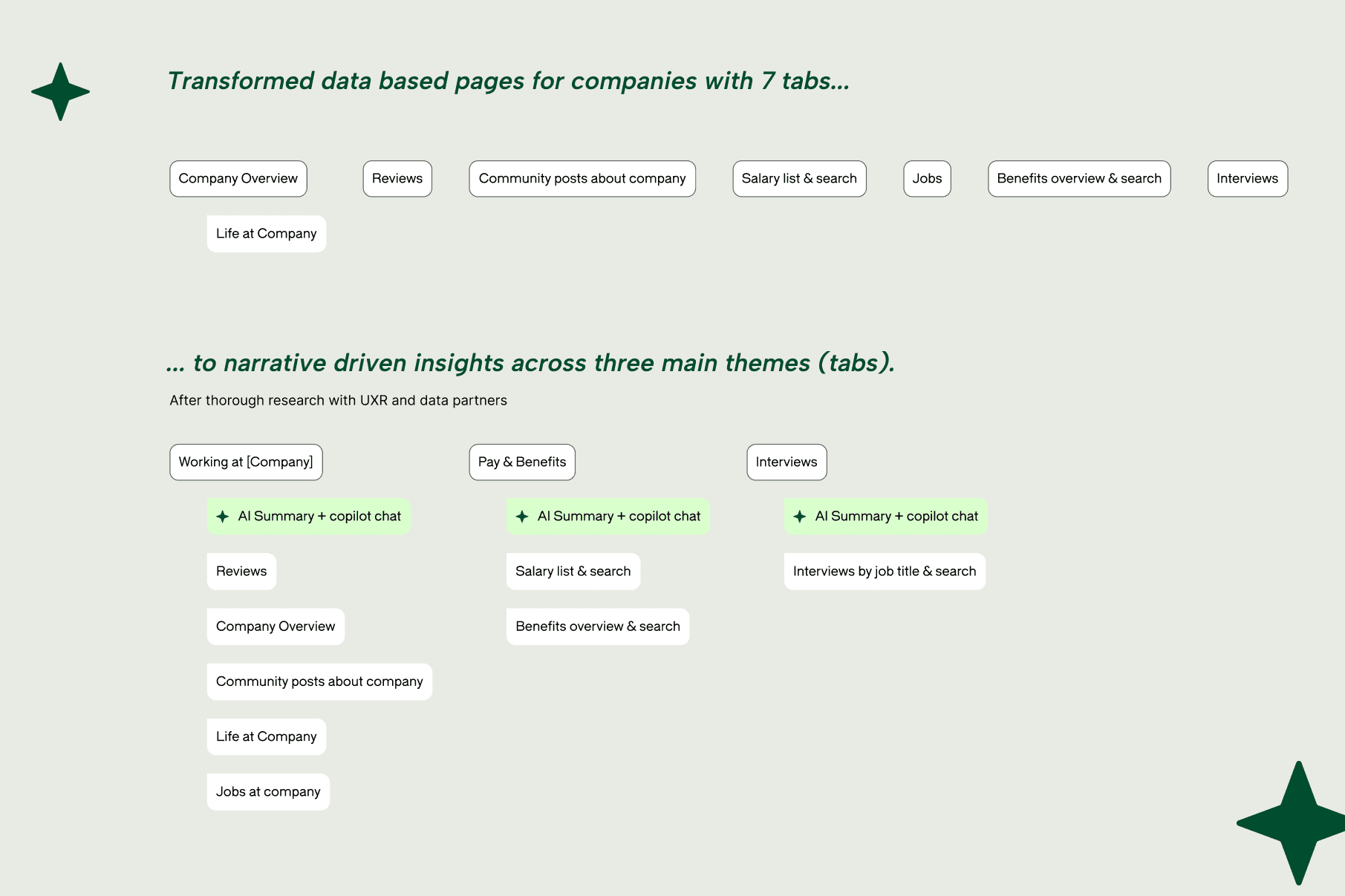
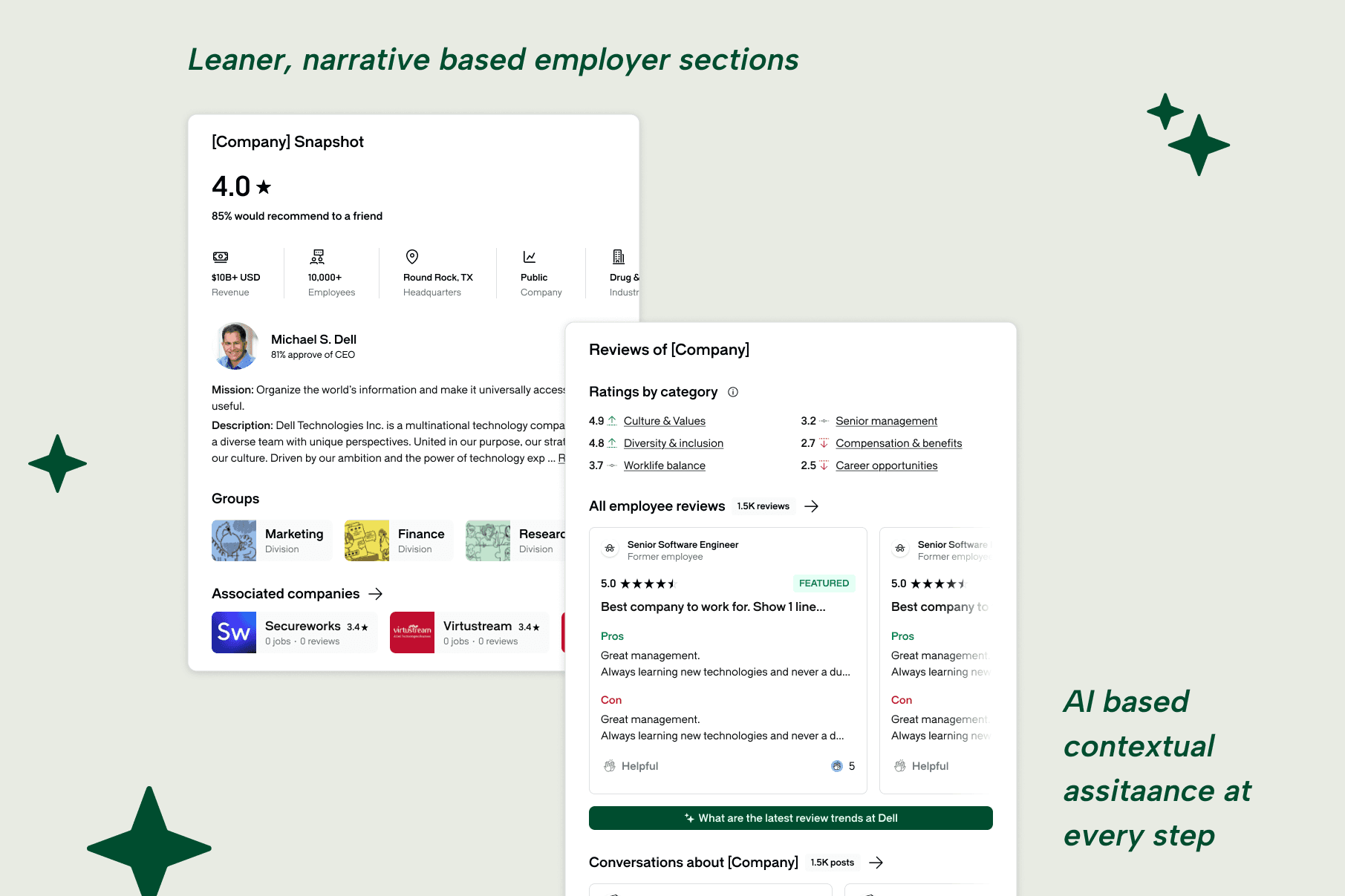
Glassdoor's employer pages were structured around our data model: 9 separate tabs for salaries, reviews, interviews, and benefits. Users had to hunt across tabs to answer simple questions like "Is this a good place to work?" or "How does the pay compare?"
The strategic design question: When should AI be an overlay versus a dedicated experience? How do users transition between browsing and AI conversations without friction?
My Approach
I led a fundamental restructure of employer pages, shifting from data-centric to intent-centric design.
From 9 data tabs to 4 user intents → Working with Product and UXR, I reorganized the entire page around what users actually need: understanding the company, reading employee experiences, evaluating compensation, and finding open roles.
Contextual AI entry points → Within each intent area, I designed AI touchpoints that surface the exact questions users have. Instead of forcing users into a chat interface, AI appears when it adds value: "What's the culture really like here?" (powered by review analysis), "How does this salary compare?" (powered by market data), or "What do employees say about work-life balance?" (powered by ratings and comments).
Seamless mode-switching → Users can browse traditionally or dive into AI-powered analysis based on their needs, then return to browsing without losing context. The interface adapts to their exploration style rather than forcing a single interaction model.
This approach transformed static company pages into intelligent analysis tools, achieving an 82% sourcing opt-in rate from employer page interactions.
Visuals
Goal #3
AI Job Summaries
The Challenge
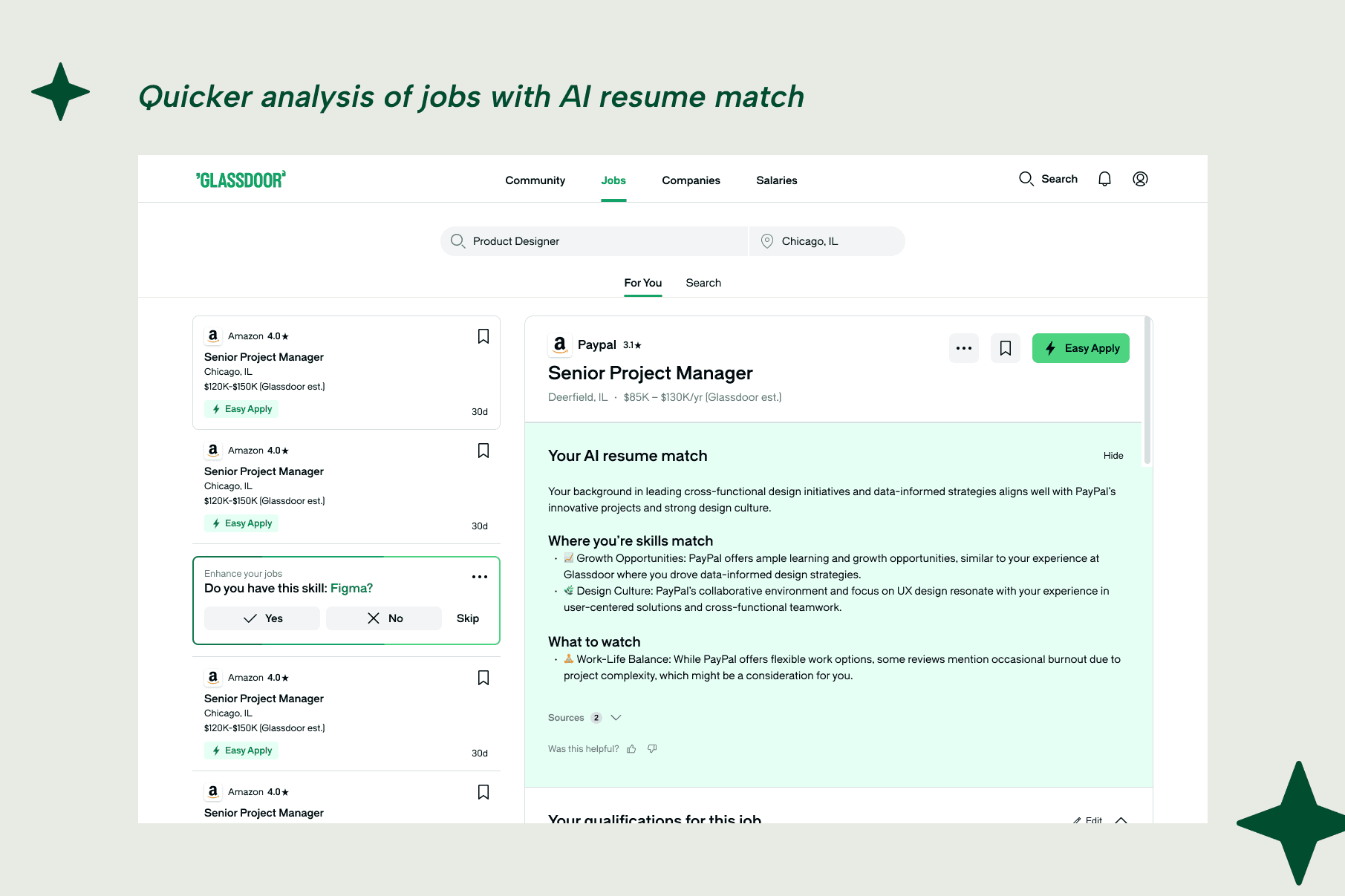
With 900K+ daily job views, users were drowning in information. Every job posting required reading through dense descriptions to understand requirements, responsibilities, and fit. At that scale, dynamically generating AI summaries for every view would be prohibitively slow and expensive—but users needed help evaluating opportunities faster.
My Approach
Instead of brute-forcing the problem with real-time LLM calls, I designed a smarter system: a curated prompt library that delivers intelligent analysis at scale.
Research-driven prompt design → I collaborated with UXR to map the most common questions users ask during job evaluation: "What are the key requirements?" "Is this remote-friendly?" "What's the salary range signal?" These insights shaped a journey-driven prompt library addressing critical decision points.
Optimized for quality and cost → Working with Data Science, I refined prompts for accuracy and value, then A/B tested variations to validate what actually helped users make decisions. This approach delivered AI-powered insights without compromising platform performance or budget.
The result: scalable intelligence that helps users understand and evaluate jobs faster, without the computational overhead of generating unique summaries for every single view.
Visuals
Outcome
Positive impact on users & business
Looking at global trends and learning from competitors, leadership set an ambitious vision:
Position Glassdoor as the executive recruiter for 2.5M+ knowledge workers.
This required a paradigm shift:
From Apply-first metrics → To Connection-first metrics
From Transactional job board → To Relationship-based talent platform
From Users searching for jobs → To Users becoming discoverable candidates
My Strategic Proposal
I begun by reviewing product's requirements and gathering insights from data and research teams.
To transform our product, I recognized three high priority paint points that could be transformed with AI: